- Divesh
- October 26, 2026
- Toxicology
- 0 Comments
Accelerant or Accident? The Chemistry of Detecting Arson
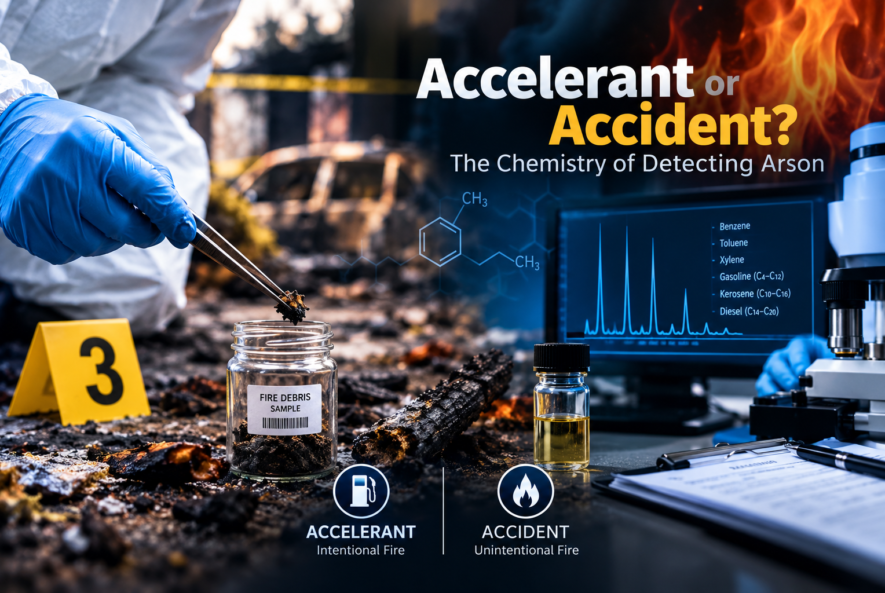
Fire wipes out evidence – that’s exactly why people who start fires count on it. Flames eat away fingerprints, footprints, and items used in crimes, leaving behind little more than ash and burnt material. But fire scene investigation has turned into one of the more chemistry-heavy corners of forensic science. It can tell apart accidental fires from those set on purpose, even from the mess they leave behind.
Why Fire Doesn’t Erase Everything
Fire behaves according to predictable physics and chemistry — it needs fuel, oxygen, and heat, and it burns in patterns shaped by all three. This means a fire scene, however destroyed, still holds a kind of “memory” of how it started and spread. Investigators are trained to read that memory in the burn patterns, char depth, and residues left behind.
What Investigators Look for at the Scene
- Burn Patterns and Fire Spread
Fires tend to move up and out from where they start, leaving a telltale “V-pattern” burned into walls. When investigators find two or more separate V-patterns with no clear link between them, that’s a warning sign. Accidental fires normally begin at a single spot and spread outward from there.
- Depth of Char
Wood burns at a rate that’s somewhat predictable. By checking how deep the charring goes in different spots, investigators can figure out how long a fire stayed burning there – and from that, where it burned longest, hottest, and earliest.
- Pour Patterns and Trailers
Liquids like gasoline or kerosene that are poured across a floor tend to pool and burn in uneven, splattered shapes. Those shapes look different from the smooth spread you’d see in an accidental fire. Burns that connect separate rooms (called “trailers”) suggest someone used a liquid to move the fire from one area to another on purpose.
The Chemistry of Catching Accelerants
- Gas Chromatography-Mass Spectrometry (GC-MS)
After taking debris samples from a scene that looks suspicious – things like burnt flooring, carpet, or soil – workers seal them up and send them off to a lab. There, a tool called GC-MS gets used. It is the same kind of tech found in toxicology labs. This method works by separating and naming the different chemical compounds sitting inside a sample. Because of that, analysts can pick up tiny traces of accelerant leftovers even after a fire has burned through them. Petroleum-based accelerants (like gasoline, diesel, and lighter fluid) each carry their own special chemical mark. So GC-MS can often figure out not just that an accelerant was there but also which one got used.
- Canine Accelerant Detection
Arson dogs with special training can smell tiny amounts of accelerant odors. Their noses work better than most lab equipment at this job. These animals often point investigators toward the spots worth sampling before people even send debris off for chemical tests. It is one of those rare times when biology beats out machinery for narrowing down where to look.
- Absorbent Materials Matter
Things that soak up liquids – carpet padding, upholstery, soil – tend to hold onto accelerant residues much better than items that got eaten away by fire’s heat. This is why investigators make it a priority to gather samples from places where accelerants probably sank in instead of surfaces that burned up fully.
Why Arson Is Still Hard to Prove
- Fire Can Mimic Itself
Accidental fires – like bad wiring, candles left alone, or chemical reactions from stored items – can leave burn marks that look a lot like someone set the fire on purpose. One example is when a room catches fire all at once from heat building up (that’s called flashover), which creates patterns that look like multiple starting points. In the past, this mix-up has led to people being wrongly convicted of arson because investigators read V-shaped burns and char marks wrong and didn’t account for flashover.
- Contamination and Chain of Custody
Accelerant leftovers show up in really tiny amounts, so things like firefighting gear, protective clothes, or even an investigator’s own tools can taint a sample by accident. That’s why careful chain-of-custody steps matter a lot – they help make sure lab results match what actually happened at the fire scene instead of some random transfer.
The Takeaway
Arson investigation lives in the space between physics and chemistry — reading the shape of destruction to understand how it began. Fire may erase the obvious evidence, but it can’t erase its own footprint entirely. For every scene that looks like nothing survived, there’s usually still a chemical trace, a burn pattern, or a pour trail waiting to tell investigators exactly what really happened.