Need Help? Book Appoinment


VIDEO EXAMINATION IN CHANDIGARH, PUNJAB AND HARYANA
Video examination is a specialized field of digital forensics concerned with the systematic examination, interpretation, and evaluation of video recordings used as potential evidence in investigative and legal matters. Digital video may contain important visual information relating to persons, objects, activities, movements, events, and sequences captured by surveillance cameras, mobile devices, dash cameras, or other recording systems. A forensic examination involves a careful review of the available footage along with consideration of relevant technical characteristics of the recording. Depending on the nature and condition of the video, the examination may help identify significant visual details, clarify events captured in the footage, and assess the consistency and integrity of the recorded material. Video evidence may be relevant in criminal investigations, surveillance-related matters, accidents, disputes, property or security incidents, and legal proceedings. The examination is conducted systematically, with appropriate consideration given to the original recording, available technical information, and the limitations of the footage, so that the findings can be documented clearly and objectively for investigative or legal use.
SERVICES
FORENSIC VIDEO EXAMINATION
Forensic video examination involves the detailed review and analysis of video recordings to identify information relevant to a particular investigation or legal matter. The examination may focus on persons, objects, vehicles, activities, movements, interactions, and events captured within the footage.
Relevant portions of the recordings may be reviewed systematically to understand what is visible and how recorded events develop over time. Where appropriate, individual frames or sequences can be examined in greater detail to identify information that may not be readily apparent during normal playback.
The examination takes into consideration the characteristics and limitations of the available recording, including image quality, resolution, lighting, camera position, compression, motion, and other factors that may affect interpretation.
VIDEO ENHANCEMENT AND IMAGE CLARIFICATION
Video recordings may sometimes contain important visual information that is difficult to observe because of poor lighting, low resolution, motion, compression, or other recording limitations.
Appropriate enhancement techniques may be applied to relevant portions of the footage to improve the visibility and clarity of information already portions of the footage to improve the visibility and clarity of information already present in the recording. Depending on the nature of the evidence, this may include adjustments to brightness, contrast, sharpness, image stabilization, noise reduction, and other suitable image-processing methods.
Enhancement is performed to assist forensic examination and interpretation. It does not create information that is not present in the original recording, and the limitations of the source footage remain relevant when interpreting the enhanced material.
FRAME-BY-FRAME VIDEO ANALYSIS
Certain events occur within a very short period and may require closer examination than normal video playback allows. Frame-by-frame analysis enables relevant portions of a recording to be reviewed at the individual-frame level.
This examination may assist in studying changes in position, movement of persons or objects, interactions, vehicle movement, entry or exit events, and other activities captured within the footage.
The analysis considers available frame rate, resolution, image quality, motion blur, compression, and other characteristics that may influence the information visible in individual frames.
VIDEO SEQUENCE AND EVENT ANALYSIS
Video examination may involve assessing the chronological sequence of recorded events and reviewing how different activities occur within the available footage.
The examination may consider the continuity of scenes, changes in camera views, movement of persons or subjects, transitions between events, and the timing of relevant activities. Where multiple recordings are available, relevant sequences may also be reviewed together to assist in understanding the overall recorded event.
Any interpretation remains dependent on the completeness and quality of the available footage.
VIDEO AUTHENTICATION AND INTEGRITY ASSESSMENT
The integrity of a questioned video recording may be an important consideration when the footage is being used as evidence. Forensic examination may assess available technical characteristics and identify indicators that could be relevant to possible editing, alteration, splicing, manipulation, or other changes to the recording.
Depending on the evidence available, the examination may consider file properties, metadata, recording characteristics, continuity of sequences, compression characteristics, and other relevant technical information.
Where the original recording or source material is available, it may provide additional information for the examination. Findings are documented with appropriate consideration of the limitations of the available evidence.
VIDEO EDITING AND MANIPULATION EXAMINATION
Digital video can be processed, converted, exported, or edited using different software and recording systems. Where a recording is questioned, forensic examination may assess relevant portions of the video for technical or visual characteristics that may be consistent with alteration or manipulation.
The examination may consider discontinuities, changes in recording characteristics, unusual transitions, inconsistencies between sequences, and other relevant indicators. Such observations are assessed in the context of the recording’s format, source, processing history, and available technical information.
The presence or absence of a particular indicator is interpreted carefully rather than relying on a single characteristic in isolation.
IMAGE AND INDIVIDUAL FRAME EXAMINATION
Individual frames can contain visual information that requires detailed examination. Relevant frames may be isolated from a recording for closer review and documentation.
Depending on the quality of the footage, frame examination may assist in assessing visible characteristics of persons, vehicles, objects, surroundings, or other elements captured in the recording.
The usefulness of individual-frame examination depends on factors such as resolution, focus, lighting, distance from the camera, obstruction, motion blur, compression, and the original recording conditions.
CCTV AND SURVEILLANCE VIDEO EXAMINATION
CCTV and surveillance systems are frequently used to record activities in residential, commercial, industrial, institutional, and other environments. The resulting footage can vary considerably in resolution, format, frame rate, compression, storage method, and camera configuration.
Forensic examination of CCTV footage may involve reviewing relevant camera recordings, identifying significant sequences, examining image quality, studying recorded events, and assessing available technical information.
Where possible, the original exported footage or native recording should be preserved because conversion, re-recording, or repeated compression may affect the available information.
DIGITAL VIDEO FILE AND TECHNICAL EXAMINATION
Digital video files contain technical characteristics that can be relevant to forensic examination. Depending on the recording and the information retained within the file, examination may consider file format, resolution, frame rate, encoding characteristics, metadata, file properties, and other available technical information.
This information may help provide context regarding the recording and its processing or export characteristics. Technical information is considered together with the actual video content rather than being interpreted independently.
VIDEO METADATA EXAMINATION
Where metadata is available and technically reliable, it may be examined as part of the overall assessment of a digital video file.
The examination may consider available information relating to the file, recording characteristics, timestamps, format, encoding, device or software information, and other relevant technical properties.
The availability and reliability of metadata can vary depending on the recording device, software, file format, export process, and subsequent handling of the file.
MULTIPLE CAMERA AND VIDEO COMPARISON
Investigations may involve footage obtained from more than one camera or recording source. Where suitable recordings are available, different video sequences may be examined and compared to assist in understanding related events.
The comparison may consider the timing and sequence of visible events, movement or persons or vehicles, changes in surroundings, and other relevant visual information.
The ability to correlate footage depends on the available recordings, their quality, timing information, camera positioning, and other technical factors.
VIDEO EVIDENCE PRESERVATION AND DOCUMENTATION
Proper preservation of digital video evidence is important because copying, conversion, compression, editing, or inappropriate handling may affect the original material or its associated information.
Where available, the original video file should be preserved in its original form. Relevant file details, source information, available metadata, and evidence-handling information may be documented as part of the examination.
Maintaining appropriate documentation helps support the traceability and integrity of the material examined.
FORENSIC VIDEO EVIDENCE ASSESSMENT
Video examination is conducted with consideration of the specific questions that need to be addressed in a case. Rather than treating every recording in the same manner, the examination approach may be adapted according to the source, format, quality, content, and condition of the evidence.
The assessment may bring together visual examination, frame analysis, sequence review, enhancement, and relevant technical information to provide a structured understanding of the available video evidence.
FORENSIC VIDEO REPORT
Findings from the examination can be documented in a structured forensic video report. The report may include details of the material examined, examination methodology, relevant observations, technical findings, limitations, and conclusions based on the available evidence.
The report is prepared in clear and professional language so that the relevant findings can be understood by clients, investigators, legal professionals, and other authorized users.
Where legally appropriate, forensic findings may also be explained in connection with investigative or legal proceedings.
ABOUT US
At Clarivue Forensics Pvt. Ltd., Video evidence is examined using a systematic and case-specific approach. Attention is given to the preservation of the available evidence, appropriate forensic examination methods, objective documentation, and clear communication of findings.
The examination is performed with an understanding that the quality and condition of a recording directly affect what can be reliably observed. CLARIVUE FORENSICS Pvt. Ltd. offers expert Forensic Video Analysis and Examination services using systematic medical methodologies for low resolution, poor lighting, motion blur, compression, obstruction, missing footage, and unavailable original files, which may limit the conclusions that can be reached, to examine, authenticate, enhance, and interpret video evidence.
Our objective is to provide a clear, scientifically reasoned, and professionally documented examination of available video evidence, while identifying the relevant findings and limitations associated with the material examined.
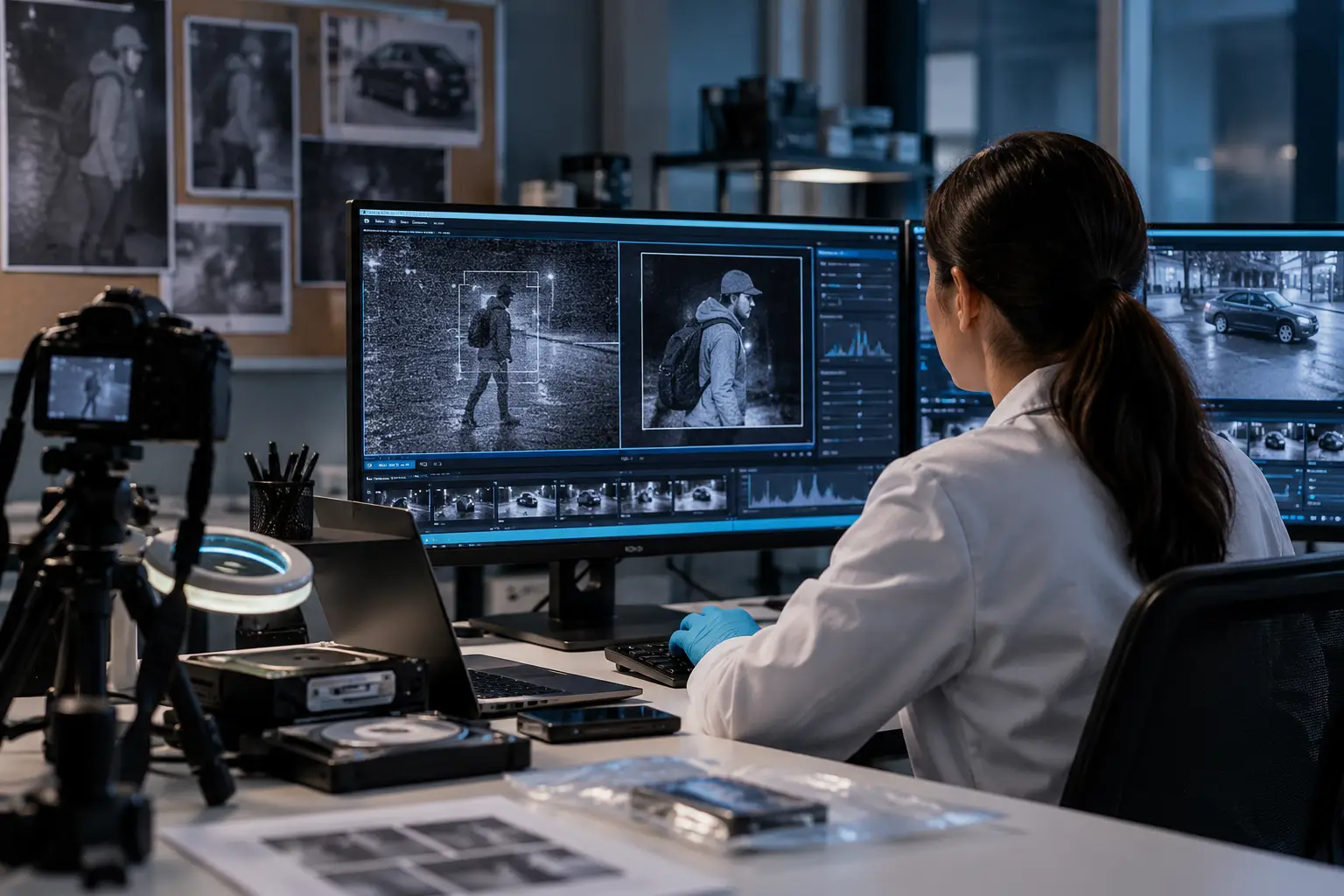
Our forensic video analysis offerings are designed to assist law enforcement agencies, prison experts, corporations, investigators, and private clients with matters involving CCTV footage, mobile phone recordings, surveillance footage, frame-worn digital camera images, and other digital video evidence.
Our experts examine video evidence for applicable visual analysis, such as identification of individuals or items, sequence of events, motion analysis, image and video enhancement, body-by-body frame examination, time and date assessment, video authentication, and extraction of relevant frames. Where technically feasible, appropriate enhancement techniques can be implemented to improve the visibility of essential info while retaining the integrity of the unique evidence.
At CLARIVUE FORENSICS, we comply with a clinical, goal-oriented, and proof-based approach. Original proof is preserved, examinations are documented systematically, and findings are offered in a clean and comprehensible forensic file.
WHY CHOOSE US
At Clarivue Forensics Pvt. Ltd., we provide systematic and professional video examination with a focus on accuracy, evidence integrity, and clear reporting.
SPECIALIZED EXPERTISE
Focused forensic examination of CCTV, surveillance, and digital video evidence.
SYSTEMATIC & CASE-SPECIFIC
Examination methods are selected according to the nature and requirements of each case.
OBJECTIVE FINDINGS
Findings are based on the available evidence, with relevant limitations clearly considered.
SECURE EVIDENCE HANDLING
Careful preservation, documentation, and handling of digital video evidence.
CLEAR REPORTING
Structured reports presenting key observations, findings, and relevant limitations.
CONFIDENTIAL & PROFESSIONAL
Confidential handling of evidence and case-related information throughout the examination process.
FORENSIC VIDEO ANALYSIS FAQS
What is forensic video analysis?
Forensic video analysis is the scientific examination of digital video recordings to identify, clarify, and document information relevant to an investigation or legal matter.
What types of video evidence can be examined?
CCTV footage, surveillance recordings, mobile videos, security camera footage, and other digital video files can be examined, depending on their condition and format.
Can poor-quality video be enhanced?
Yes. Appropriate enhancement techniques may improve the visibility of information already present in the footage. However, enhancement cannot create details that are not contained in the original recording.
Can you examine whether a video has been edited or manipulated?
Video examination may assess technical and visual characteristics that could be relevant to possible editing, alteration, splicing, or manipulation.
Can individual frames of a video be examined?
Yes. Relevant frames can be isolated and examined to study persons, objects, vehicles, movements, or other visible details.
Can CCTV footage be examined?
Yes. CCTV and surveillance recordings can be examined for image quality, recorded events, sequences, movement, and available technical information.
Can the metadata of a video file be examined?
Where metadata is available, relevant file information such as format, timestamps, encoding, and other technical characteristics may be examined.
Can multiple video recordings be compared?
Yes. Where suitable recordings are available, footage from different cameras or sources may be compared based on timing, sequences, movements, and visible events.
What affects the results of forensic video examination?
Factors such as resolution, lighting, compression, motion blur, camera position, frame rate, obstruction, and the availability of the original recording can affect the examination.
Will I receive a forensic report?
Yes. Findings can be documented in a structured report covering the material examined, methodology, observations, relevant findings, limitations, and conclusions.
Top 15 Video Forensic expert services keywords to reach us in Chandigarh, India
Forensic Video Examination
Video Enhancement
CCTV Video Examination
Frame-by-Frame Analysis
Video Authentication
Video Tampering Detection
Video Sequence Analysis
Image and Frame Analysis
Person and Object Movement Analysis
Digital Video File Examination
Video Metadata Examination
Multiple Camera Video Comparison
Video Evidence Preservation
Video Evidence Analysis & Documentation
Forensic Video Reports & Expert Opinion
Forensic Video Examination – Service Areas
Chandigarh & Tricity
Chandigarh • Mohali • New Chandigarh • Zirakpur • Kharar • Panchkula
Punjab
Barnala • Bathinda • Faridkot • Fatehgarh Sahib • Fazilka • Ferozepur • Gurdaspur • Hoshiarpur • Jalandhar • Kapurthala • Ludhiana • Rupnagar • Mansa • Moga • Pathankot • Patiala • Sangrur • Nawanshahr • Sri Muktsar Sahib • Tarn Taran • Malerkotla
Haryana
Ambala City • Ambala Cantt • Panipat • Hisar • Sonipat • Karnal • Jind • Rohtak • Kurukshetra • Yamunanagar • Gurugram • Palwal • Faridabad • Nuh • Mahendragarh • Rewari • Fatehabad • Sirsa • Bhiwani • Charkhi Dadri • Jhajjar • Kaithal