

THE COLIN PITCHFORK CASE: THE DNA EVIDENCE THAT CHANGED CRIMINAL INVESTIGATION
“When science can distinguish the innocent from the guilty, evidence becomes more than a clue—it becomes a path to the truth.”
Introduction
Background of the Case
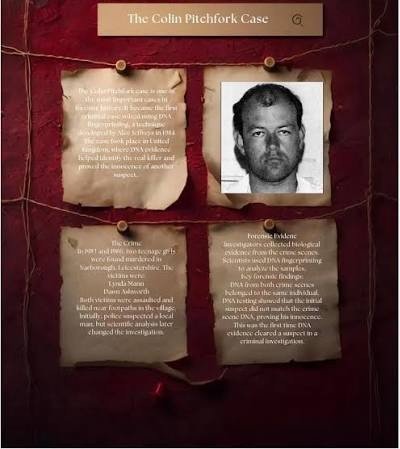
The Colin Pitchfork case is one of the most important cases in the history of forensic science because it was the first criminal investigation in which DNA profiling was successfully used to identify the offender and secure a conviction.
The case involved the rape and murder of two young girls in Leicestershire, England. It also demonstrated something equally important: forensic DNA evidence did not simply help identify a suspect—it first helped prove that an earlier suspect was not responsible.
The scientific technique used in the investigation was developed by Professor Sir Alec Jeffreys at the University of Leicester. DNA fingerprinting had been discovered in 1984, and its first use in a criminal investigation occurred during the investigation of the Leicestershire murders.
The investigation began after the murder of Lynda Mann, a 15-year-old girl from the Narborough area of Leicestershire.
On 21 November 1983, Lynda was found dead near a footpath in the village of Narborough, Leicestershire. Forensic examination established that she had been sexually assaulted before her death.
The case remained unsolved for several years.
In July 1986, another 15-year-old girl, Dawn Ashworth, disappeared while walking home in the nearby village of Enderby. Her body was later discovered in an area known as Ten Pound Lane.
The similarities between the two cases led investigators to believe that the same person could be responsible.
The two murders therefore became connected investigations, and police began searching for evidence that could identify the offender.
The Initial Investigation
The Role of DNA Profiling
During the investigation into Dawn Ashworth's murder, a local young man named Richard Buckland was arrested.
Buckland confessed to Dawn's murder but denied involvement in Lynda Mann's death.
Investigators initially considered that his confession might solve the second murder and potentially connect him to the first. However, the newly developing technique of DNA profiling provided an opportunity to scientifically test whether the biological evidence from the crime scenes actually belonged to Buckland.
This became a turning point in the investigation.
Professor Sir Alec Jeffreys, a geneticist at the University of Leicester, had developed the technique known as DNA fingerprinting.
The police provided biological material associated with the two murders for DNA analysis.
The DNA profiles obtained from the crime-scene samples were found to be consistent with the same unknown male.
However, they did not match Richard Buckland.
This was a major breakthrough because DNA evidence showed that Buckland was not the source of the biological material associated with the murders. He was therefore excluded as the offender responsible for the biological evidence.
The case became an early and powerful demonstration that forensic science could protect an innocent person from being wrongly convicted.
The Mass DNA Screening
How Colin Pitchfork Was Identified
After Buckland was excluded, police faced a new problem:
Who was the unknown man whose DNA profile matched the evidence from both crime scenes?
Leicestershire Police organized a large-scale voluntary blood-sampling programme involving local men.
Approximately 5,000 men were asked to provide samples as part of the investigation. The purpose was to compare their DNA profiles with the unknown profile obtained from the crime-scene evidence.
Despite the large number of samples examined, no initial match was found.
The investigation eventually took an unexpected turn.
Police learned that Colin Pitchfork, a local man who worked as a baker, had arranged for another man to provide a blood sample on his behalf.
Pitchfork's attempt to avoid providing his own sample became an important investigative lead.
Police obtained a sample from Pitchfork himself and compared his DNA profile with the profile obtained from the crime-scene evidence.
The result was a match.
The DNA evidence linked Pitchfork to the biological material associated with both murders.
He was subsequently arrested and prosecuted. The University of Leicester records that Pitchfork became the first person convicted of murder using DNA fingerprinting.
Important Forensic Evidence
Important Forensic Evidence
1. Biological evidence
Biological material recovered during the investigation provided the basis for DNA analysis.
2. DNA profiling
DNA profiles obtained from evidence associated with the two murders were consistent with the same male individual.
3. Exclusion of Richard Buckland
The DNA profile did not match Buckland, helping prevent a wrongful conviction.
4. DNA match to Colin Pitchfork
Pitchfork's DNA profile matched the profile obtained from the crime-scene material.
5. Supporting investigative evidence
The DNA findings were considered together with the wider police investigation and other evidence presented during the criminal proceedings.
Following the DNA match and subsequent investigation, Colin Pitchfork was charged with the murders of Lynda Mann and Dawn Ashworth.
He was convicted in 1987.
The case is commonly described by the UK Government and University of Leicester as the first successful criminal conviction based on DNA profiling.
Government records state that Pitchfork was sentenced to life imprisonment for the two murders.
Why This Case Changed Forensic Science
Conclusion
The Colin Pitchfork case occupies an important place in forensic-science history. It was not simply a case in which DNA helped catch a criminal. It was a case that demonstrated how scientific evidence could challenge an existing assumption, protect an innocent person and ultimately identify the actual offender.
The investigation helped establish DNA profiling as one of the most influential technologies in modern forensic science. Since then, DNA profiling has become an important tool in criminal investigations and human identification around the world.