Jessica Lal Murder Case
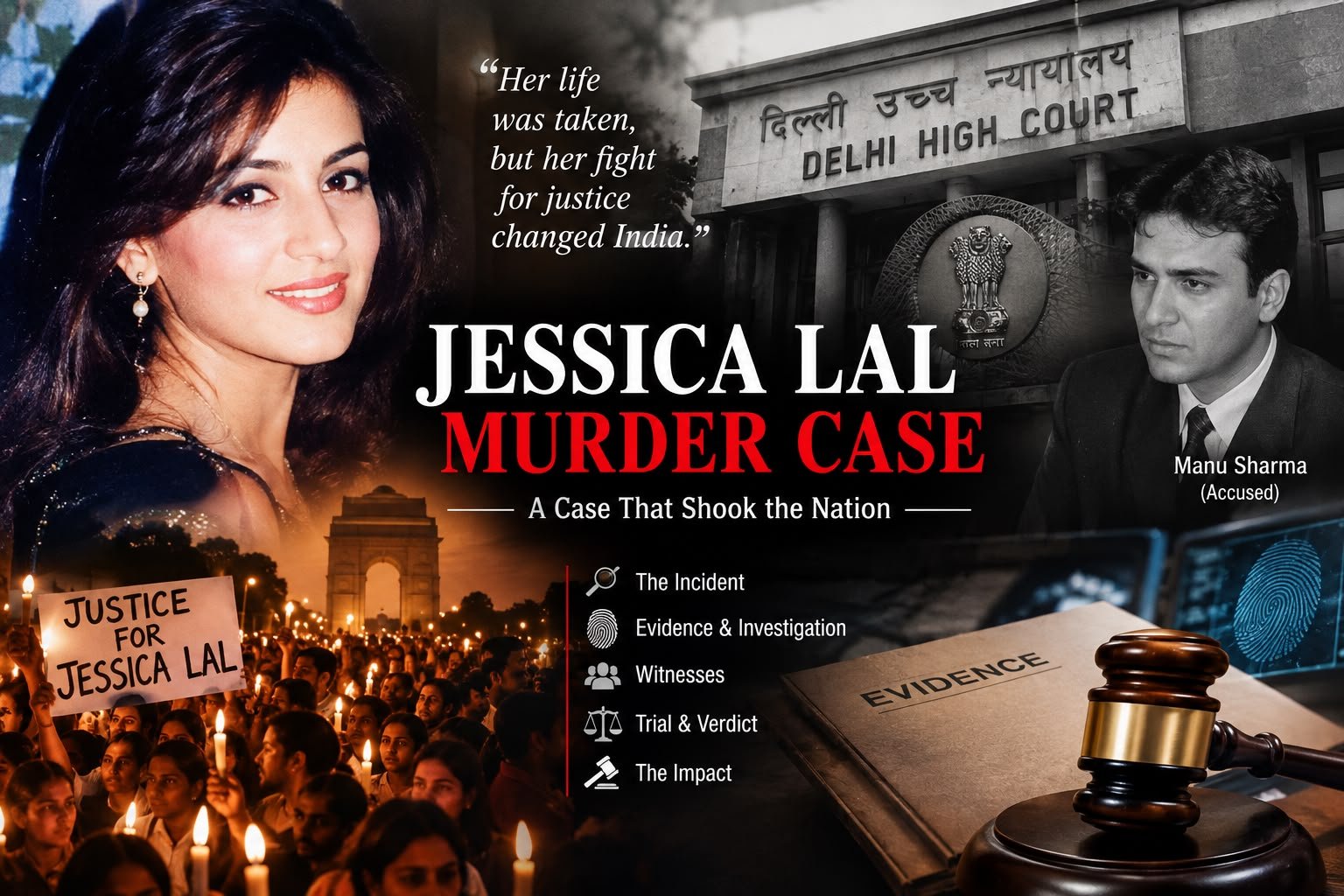
The Jessica Lal murder case is an important Indian forensic case because it demonstrates the role of ballistic examination, cartridge-case analysis, crime-scene evidence, witness evidence, and expert testimony in a criminal investigation.
1. Background of the Case
Jessica Lal was working at a private party at Tamarind Court Café, Qutub Colonnade, Mehrauli, Delhi, during the night of 29–30 April 1999. During the party, an altercation occurred after Jessica refused to serve a drink. She was subsequently shot and died after being taken to hospital. The accused was Siddhartha Vashisht, commonly known as Manu Sharma.
The case initially resulted in an acquittal at the trial-court level, but the Delhi High Court later convicted Sharma in 2006. The Supreme Court upheld the conviction and life sentence in 2010.
2. Crime- Scene Investigation
The crime scene was examined, and physical evidence was collected. Among the important pieces of evidence were spent cartridge cases recovered during the investigation.
The investigation subsequently focused heavily on determining:
The calibre of the ammunition.
Whether the cartridge cases had been fired from a pistol or revolver.
Whether the cartridge cases had been fired from the same firearm.
Whether the firearm evidence was consistent with the prosecution's account
3. Forensic Ballistic Examination
One of the most important forensic aspects of this case was the examination of the cartridge cases.
A forensic expert was asked three principal questions:
1. What was the bore/calibre of the two cartridge cases?
2. Were they fired from a pistol or revolver?
3. Were both cartridge cases fired from the same firearm?
The laboratory report identified the cartridge cases as .22 calibre and indicated that they appeared to have been fired from a pistol.
Why this was important
Forensic firearm examination can compare characteristics left on cartridge cases during firing. These may help determine whether particular ammunition is associated with a particular firearm when the firearm is available for examination.
Important forensic principle:
An expert opinion has to be interpreted together with the underlying evidence; it is not automatically conclusive by itself.
4. Firearm Evidence
The prosecution evidence included material connecting Manu Sharma with a licensed .22-bore pistol and ammunition.
The Delhi High Court noted that Sharma had a licensed pistol of .22 bore and that a similar live cartridge was recovered from the abandoned Tata Safari. The court considered this evidence along with eyewitness testimony and other circumstances.
The firearm itself was an important issue because its availability for forensic examination affected what conclusions could be drawn from the cartridge evidence.
5. Expert Forensic Evidence
An interesting aspect of this case is that a forensic expert's evidence later became the subject of separate legal proceedings.
The State Forensic Science Laboratory, Rajasthan had been asked to examine the cartridge cases. The expert gave a qualified opinion, and the High Court subsequently questioned aspects of the expert's testimony.
The matter eventually reached the Supreme Court in Prem Sagar Manocha v. State (NCT of Delhi).
In 2016, the Supreme Court held that merely giving an inconclusive or qualified expert opinion does not automatically amount to perjury. The Court emphasized that an expert's role is to provide an opinion with its scientific basis, while the court evaluates the evidentiary value of that opinion.
6. Eye witness and Forensic Evidence
Several witnesses were examined during the case. Some witnesses changed their accounts or became hostile, while others continued to support the prosecution.
The Delhi High Court found the testimony of Bina Ramani, among others, significant. The court also considered forensic and circumstantial evidence connecting Sharma with the incident.
The Supreme Court later held that the conviction could be supported by credible witness testimony together with other evidence, despite some witnesses turning hostile
7. Evidences Connecting the Accused
The courts considered several categories of evidence, including:
A. Eyewitness testimony
Witnesses placed Sharma at the scene and gave evidence regarding the shooting.
B. Cartridge evidence
The recovered cartridge cases were examined by a forensic laboratory and identified as .22 calibre.
C. Firearm and ammunition evidence
Evidence regarding Sharma's possession of a .22-bore licensed pistol and ammunition was considered by the courts.
D. Abandoned vehicle
The Tata Safari associated with Sharma was abandoned after the incident, and a similar live cartridge was recovered from it. The High Court treated this as part of the circumstantial evidence.
E. Conduct after the incident
The courts also considered Sharma's conduct after the shooting as part of the overall circumstantial evidence.
8. Trial Court Decision
The initial trial resulted in acquittal of the accused.
The prosecution case had been weakened by problems including witnesses turning hostile and difficulties surrounding the interpretation of evidence. The trial court was not satisfied that the prosecution had established guilt beyond reasonable doubt.
This decision resulted in substantial public criticism and attention.
9. Delhi High Court Decision – 2006
The Delhi High Court reconsidered the evidence and convicted Manu Sharma in December 2006.
The High Court relied on the testimony of witnesses whom it found credible, together with forensic and circumstantial evidence. It rejected the defence theory concerning the existence of another shooter.
Sharma was sentenced to life imprisonment.
10. Supreme Court Decision- 2010
The matter ultimately reached the Supreme Court of India.
On 19 April 2010, the Supreme Court upheld Sharma's conviction and life sentence. The Court considered the combined effect of eyewitness testimony, cartridge/firearm evidence, evidence concerning vehicles and ammunition, and his conduct after the incident.