

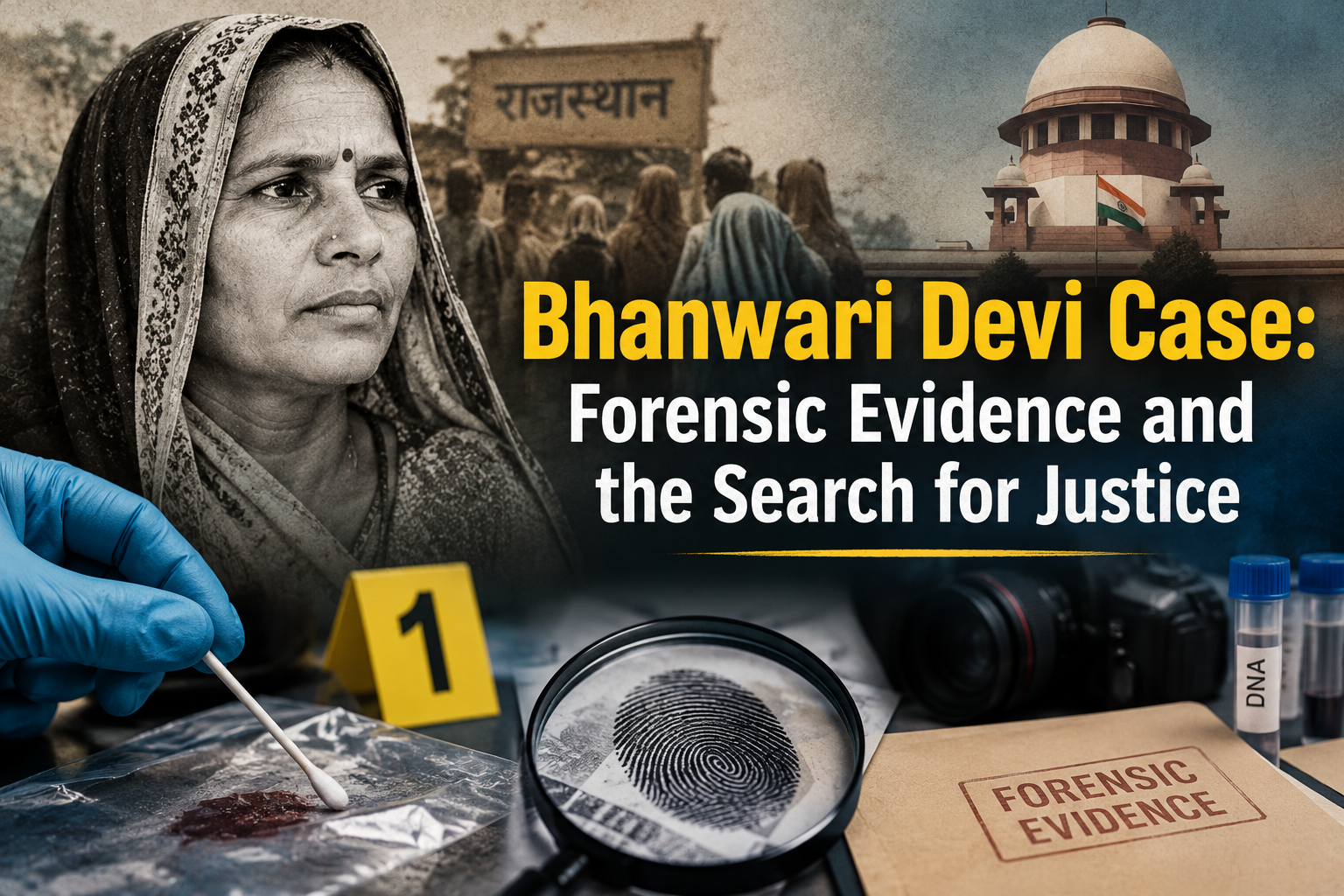
Bhanwari Devi Case: Forensic Evidence and the Search for Justice
“Sometimes, the most important evidence is not what is immediately seen, but what science can uncover years later.”
Introduction
The Bhanwari Devi case is one of the significant cases in the history of criminal justice and women's rights in India. It began in 1992 in Bhateri village, Rajasthan, and later developed into a long-running investigation involving disappearance, suspected murder, recovery of skeletal remains and advanced DNA analysis.
The case is particularly relevant to forensic science because investigators eventually recovered burnt bone fragments believed to belong to Bhanwari Devi. Conventional forensic laboratories initially found it difficult to obtain a useful DNA profile from the badly burnt material. The samples were therefore sent to the Federal Bureau of Investigation (FBI), USA, where DNA analysis was eventually used to establish the identity of the remains.
Background
Bhanwari Devi was a government-appointed Sathin, a grassroots worker associated with efforts to prevent child marriage and promote social awareness in rural Rajasthan.
In 1992, she attempted to intervene in a child marriage in her village. Her intervention created opposition from some members of the local community.
According to the subsequent investigation and prosecution case, she was attacked in September 1992. The case initially attracted attention because of allegations of sexual assault and the difficulties Bhanwari Devi faced in obtaining an immediate police and medical response.
The National Commission for Women records that the authorities initially failed to respond adequately to her complaint and that the matter eventually came under a Central Bureau of Investigation inquiry.
The 1992 Incident
The incident occurred in September 1992 near Bhateri village.
Bhanwari Devi reported that a group of men had attacked her and that she had been sexually assaulted while her husband was restrained.
The investigation and subsequent court proceedings became highly controversial. The CBI investigated the allegations and filed charges against five men.
The trial eventually ended in November 1995, when the trial court acquitted all five accused. The verdict generated widespread criticism and protests, making the case an important part of discussions about the treatment of sexual-assault survivors and access to justice in India.
Disappearance and Later Investigation
Years later, the case took a different forensic direction.
Bhanwari Devi could not be traced, and investigators subsequently developed evidence suggesting that she had been killed and that her body had been disposed of.
The CBI investigation eventually led investigators to the Rajiv Gandhi Lift Canal in Rajasthan, where burnt bone fragments were recovered.
This created a major forensic problem: the material was severely damaged by burning, making conventional identification extremely difficult.
Recovery of Forensic Evidence
DNA Examination at the FBI
The CBI subsequently sent the burnt bone samples to the FBI Forensic Laboratory in the United States through the U.S. Embassy in New Delhi.
The purpose was to determine whether DNA could be extracted from the remains and compared with biological reference samples from Bhanwari Devi's children.
The FBI examined the material and produced a DNA report dated 25 May 2012.
The DNA results provided the scientific basis for identifying the recovered burnt remains as belonging to Bhanwari Devi. The report was subsequently placed before the Indian trial court as additional evidence.
Why the DNA Evidence Was Important
The case demonstrates one of the most important applications of forensic DNA analysis: identification of unknown human remains.
In this situation, ordinary visual identification was impossible because the remains had been extensively burnt and fragmented.
DNA analysis allowed investigators to compare genetic material recovered from the remains with reference samples from close biological relatives.
The basic forensic process can be represented as:
Unknown remains → DNA extraction → DNA profiling → comparison with relatives → statistical interpretation → identification.
Further Investigation
The CBI continued its investigation into the disappearance and suspected murder.
Evidence collected during the investigation was used to frame charges against different accused persons in connection with the alleged conspiracy, abduction, murder and destruction of evidence.
The later proceedings included charges under provisions of the Indian Penal Code, including Sections 120-B, 364/120-B, 302/120-B and 201, along with provisions of the Scheduled Castes and Scheduled Tribes (Prevention of Atrocities) Act in the relevant proceedings.
Court Proceedings and Judgment
The Bhanwari Devi matter involved a complicated series of proceedings rather than one single trial.
The original 1992 sexual-assault case ended with the acquittal of the five accused by the trial court in November 1995.
The later investigation into Bhanwari Devi's disappearance and suspected murder was pursued separately. After the recovery and DNA identification of the remains, further criminal proceedings were initiated against persons accused of involvement in her disappearance and death.
The Rajasthan High Court records that the CBI filed its original chargesheet in December 2011, followed by supplementary chargesheets as further evidence emerged.
Punishment and Legal Outcome
The legal outcome should be described carefully because the Bhanwari Devi matter contains multiple accused, multiple proceedings and different stages of litigation.
The original sexual-assault case resulted in the acquittal of the five accused in November 1995. The later disappearance/murder investigation resulted in separate proceedings against several accused.
Therefore, it would be inaccurate to state simply that “the Bhanwari Devi case ended with X punishment.” The punishment and findings depend on the specific later accused and proceeding being discussed.
Forensic Significance
The Bhanwari Devi case is particularly important because it demonstrates several applications of forensic science:
1. DNA identification of human remains
The most distinctive forensic feature was the use of DNA analysis to identify severely burnt skeletal remains.
2. Forensic anthropology
The examination of bones, skull fragments and teeth was important in determining whether the recovered material represented human remains and in supporting the identification process.
3. DNA from challenging samples
The case demonstrates that severely damaged biological material can present major laboratory challenges and may require specialized techniques and facilities.
4. Kinship comparison
Instead of relying on direct DNA from the missing person, investigators compared DNA obtained from the remains with reference samples from her children.
5. International forensic cooperation
The case also demonstrates how specialized forensic facilities in another country may be used when the required technology or expertise is not readily available locally.
6. Importance of evidence interpretation
The case highlights that scientific evidence must be interpreted within its limitations. DNA identification can establish the identity of human remains, but other evidence is needed to establish the circumstances of death and responsibility for a crime.
“Evidence may be buried, damaged or forgotten—but science can sometimes bring its identity back to light.”